
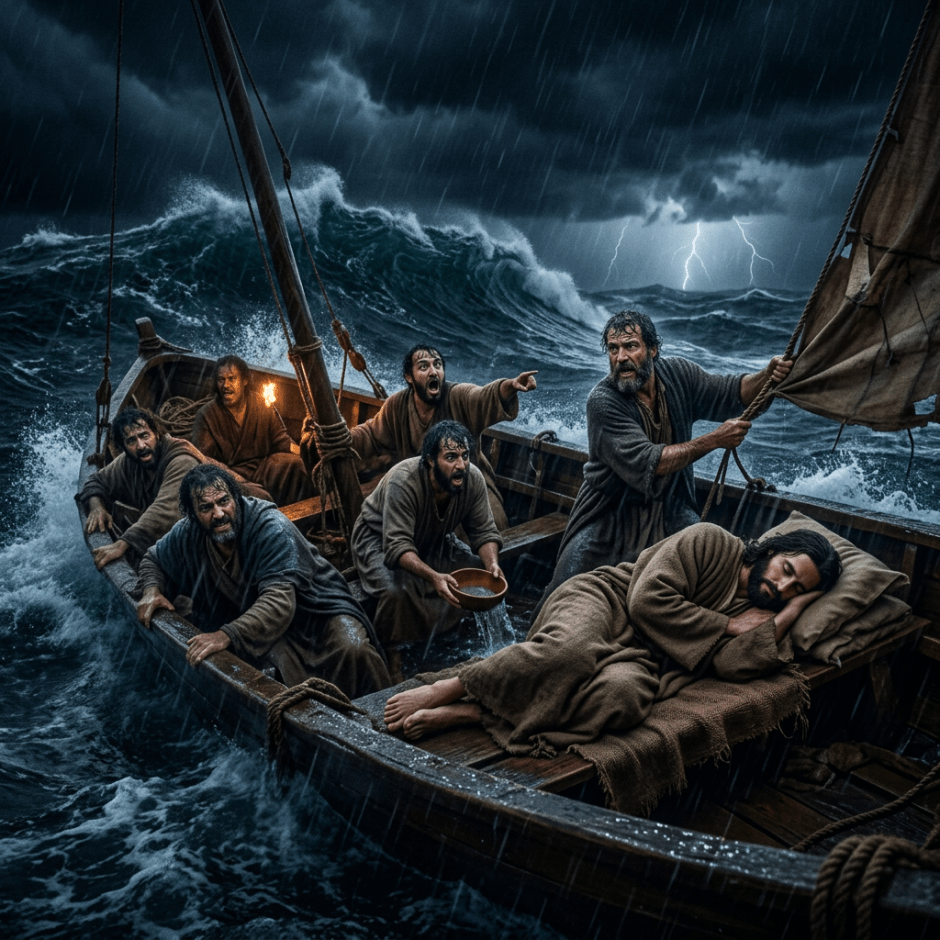
They Had God in the Boat

The disciples could have laughed in the face of the storm.

After all, they had God Himself in their boat.

In Matthew 8, Jesus and His disciples got into a boat to cross over to the other side. As they sailed, a violent storm suddenly arose. The waves crashed into the boat, and the situation became so serious that experienced fishermen began to panic.

But in the middle of it all, Jesus was asleep.

The disciples rushed to wake Him up saying,
“Lord, save us! We’re going to die!”

Jesus arose, rebuked the winds and the sea, and immediately there was a great calm.

Then the disciples said to one another:
“What kind of man is this? Even the winds and the sea obey Him.”

That question revealed something important:
they were around Jesus, but they still did not fully know who He was.

If they truly understood the One who was in the boat with them, fear would not have been their first response to the storm.

Their fearful response exposed a gap in their revelation of Jesus.

Just like the disciples, many of us spend a lot of time around God and still do not truly know Him.

You can be familiar with church, familiar with scripture, familiar with worship songs, familiar with Christian language — and still lack a personal revelation of who God is.

Unfortunately, when things become familiar, we often stop pursuing them intentionally.

That is what happens to many believers.

Over time, Christianity can quietly become routine.
Prayer becomes habit.
Bible study becomes a daily task.
Church becomes attendance.

Without realising it, passion is replaced with familiarity.

We can see from the story above that familiarity doesn’t always result in a true revelation of God.

A lack of true revelation is often exposed when the storms of life arise.

Why?

Because a believer’s strength in the storm is their confidence in God.

But confidence in God can only come from truly knowing Him — not merely hearing about Him on Sundays.

This is why many people discover during difficult seasons that they do not trust God as deeply as they thought they did.

The disciples discovered this in the storm.

They were afraid because they did not fully understand who was with them.

Those who truly know God can stand firm even in storms.

So pause for a moment and honestly ask yourself:

Who do I know God to be?

Not:
Who have I been told He is?

Not:
Who does my pastor say He is?

But:
Who do I truly believe He is for myself?

Because the answer to that question will determine how you respond when the storms of life come your way.

Prayer:

Lord, give me more than familiarity with You.
Give me true revelation.

Help me to know You deeply — not just through what I have heard, but through genuine intimacy with You.

Let my confidence in You be rooted in revelation, so that when the storms of life arise, fear will not overcome me.

Open my eyes to who You truly are, and teach me to trust You completely.

Amen.

Nobody Hides Light!

“You are the light of the world. A city that is set on a hill cannot be hidden. Nor do they light a lamp and put it under a basket, but on a lampstand, and it gives light to all who are in the house. Let your light so shine before men, that they may see your good works and glorify your Father in heaven.”
Matthew 5:14–16 (NKJV)

You are the light of the world—not just the light of the church.

The life God has called us to live produces light everywhere—at work, on the bus, in the supermarket.

“A city set on a hill cannot be hidden.”
Why would Jesus make such an obvious statement?

He follows it with another:
“No one lights a lamp and hides it.”

If someone said that today, someone in the crowd would probably whisper, “Well… obviously.”

Exactly.

It makes no sense to hide light.

And yet, many of us do.

If we truly see ourselves as light, then hiding should feel unnatural. But the life we’re called to live can make us look different—sometimes even weird or foolish to the world. So we fall into the trap of hiding… or “shape shifting.”

What do I mean by shape shifting? 😂

It’s when we put on a Christian persona in church or around Christian friends, then switch up our vibe in secular spaces.

But Jesus didn’t call us to hide the Kingdom lifestyle.

You may look different—but your difference is the light the world needs. It reveals to a lost world the original blueprint for living.

As we live out the Kingdom lifestyle everywhere we go, God is glorified—by both believers and unbelievers.

So the next time you feel that nudge to shrink back, to blend in, to hide…

Remember:

Nobody hides light.

Run to Obtain

Imagine writing a 100,000-word essay—and your laptop shuts down before you save it. Or running a marathon, crossing the finish line, only to be told you’re disqualified because you didn’t follow the rules. Frustrating, right? That’s how it can feel when we run our Christian race without paying attention to how we run.

The Bible compares our lives to running a race, with a heavenly prize in view:

“Do you not know that those who run in a race all run, but one receives the prize? Run in such a way that you may obtain it.”
I Corinthians 9:24 NKJV

“Therefore we also, since we are surrounded by so great a cloud of witnesses, let us lay aside every weight, and the sin which so easily ensnares us, and let us run with endurance the race that is set before us.”
Hebrews 12:1 NKJ
V

“Blessed be the God and Father of our Lord Jesus Christ, who according to His abundant mercy has begotten us again to a living hope through the resurrection of Jesus Christ from the dead, to an inheritance incorruptible and undefiled and that does not fade away, reserved in heaven for you.”
I Peter 1:3–4 NKJV

Hidden within these scriptures is a gentle warning: our lives as Christians is a race and we must be careful how we run the race.

If Paul encourages us to run in such a way as to obtain the prize, it means it is possible to run and not obtain it.

“But I discipline my body and bring it into subjection, lest, when I have preached to others, I myself should become disqualified.”
I Corinthians 9:27 NKJV

There are disciplines and rules we are expected to live by in this kingdom. Simply put, the end does not justify the means.

We receive both the end and the means from God’s Word.

Another way to say this is: we cannot do God’s work using the world’s methods and still expect God’s reward. We obey His instructions, using His methods, to receive His reward.

It is wonderful to run—but we must run the right way.

“Now if anyone builds on this foundation with gold, silver, precious stones, wood, hay, straw, each one’s work will become clear; for the Day will declare it, because it will be revealed by fire; and the fire will test each one’s work, of what sort it is. If anyone’s work which he has built on it endures, he will receive a reward. If anyone’s work is burned, he will suffer loss; but he himself will be saved, yet so as through fire.”
I Corinthians 3:12–15 NKJV

This scripture warns us to take heed not only that we build, but how we build and with what materials, because our work will be tested at the end. Only that which endures the testing will be rewarded.

For the purpose of this post, I would like to highlight two traps we easily fall into that may compromise the reward we receive for our good works.

  1. Doing things to be seen by men.

In Matthew 6, Jesus, while teaching on giving, praying, and fasting, repeatedly warned us not to do these things to be seen by men. Believe it or not, this is a very easy trap to fall into.

We rarely start here, but along the journey people may begin to commend us for our good deeds. They may say things like, “Wow, you are so prayerful,” or “You break down Scripture so well.”

If we are not careful, our hearts begin to tilt, and we slowly start doing what we do for the praise of men.

“And though I bestow all my goods to feed the poor, and though I give my body to be burned, but have not love, it profits me nothing.”
I Corinthians 13:3 NKJV

Have you ever wondered about this scripture?

How can someone give all their goods to the poor and yet not have love?

I know at least one answer: the praise of men.

According to Jesus, when we live this way, we lose our reward.

“Take heed that you do not do your charitable deeds before men, to be seen by them. Otherwise you have no reward from your Father in heaven.”
Matthew 6:1 NKJV

  1. Never truly seeking to know Christ

Christ died so that we may have eternal life. And what is eternal life? That we may know God and Jesus Christ whom He sent (John 17:3).

“Not everyone who says to Me, ‘Lord, Lord,’ shall enter the kingdom of heaven, but he who does the will of My Father in heaven. Many will say to Me in that day, ‘Lord, Lord, have we not prophesied in Your name, cast out demons in Your name, and done many wonders in Your name?’ And then I will declare to them, ‘I never knew you; depart from Me you who practice lawlessness!’”
Matthew 7:21–23 NKJV

Just like the people in the scripture above, it is possible to go through the motions of being a Christian and yet never truly seek to know God and His Christ. These individuals even worked miracles and cast out demons, yet they were not known by God. They were living life by their own rules and according to their own ambitions, rather than by obedience to God.

Let us therefore walk carefully, with our steps ordered by God and guided by His Word, so that we may live lives pleasing to Him and, in the end, receive that imperishable crown.

Prayer:
Lord, please grant me the grace to run this life’s race in such a way that I will receive my heavenly reward. Amen.

Living from the Inside Out

As we step into a new year, many people are drawing up long lists of resolutions they hope to keep.

According to ChatGPT, the three most common New Year’s resolutions are:

1. Improve physical health : This often means exercising more, eating healthier, losing weight, or being more active overall.

2. Improve finances : Common goals include saving more money, paying off debt, sticking to a budget, or spending less.

3. Improve mental well-being: These are usually resolutions to get better sleep, reduce stress, or improve work–life balance.

Many of us can relate to one or two of these goals. And while they are all worthwhile, there is one area we must not neglect: our spiritual health.

Human beings are made up of spirit, soul, and body.

While we often attend to the needs of the soul and body, we sometimes forget that our spirit also has needs—and these needs should be prioritised.

The spirit of a man will sustain him in sickness, but who can bear a broken spirit?”

— Proverbs 18:14 (NKJV)

Our spirit man actually carries the rest of our being. It is the support system for both our soul and our body. When the spirit is strengthened, it sustains everything else.

We live a richer and more fulfilling life when we live from the inside out, prioritising our spiritual needs.

Jesus Himself emphasised this truth:

It is written, ‘Man shall not live by bread alone, but by every word that proceeds from the mouth of God.’”

— Matthew 4:4 (NKJV)

Here, He highlights that while physical food is necessary, it is not sufficient. True life and sustenance come from the words that proceed from the mouth of God.

So where do we find these words?

In the place of personal fellowship with God and in the gathering of fellow believers.

So before you sign up for that annual gym membership or that healthy eating workshop, pause and ask yourself:

How can I tend to my spirit man?

How can I practically position myself to consistently receive the words that proceed from God’s mouth this year—and in the years to come?

In other words:

How do I spend even more time with God this year, both personally and corporately?